
Barge-in is the difference between a voice agent and a recording
Play someone a synthesised voice and they will forgive a lot: an accent that is not
quite local, a slightly flat delivery, a pause in the wrong place. What they will
not forgive is talking over them.
Interruption is how people establish that the other side is listening. In a normal
conversation you start speaking, the other person stops within a couple of hundred
milliseconds, and the exchange continues. When that does not happen, the caller
concludes — correctly — that nothing is listening, and starts pressing 0.
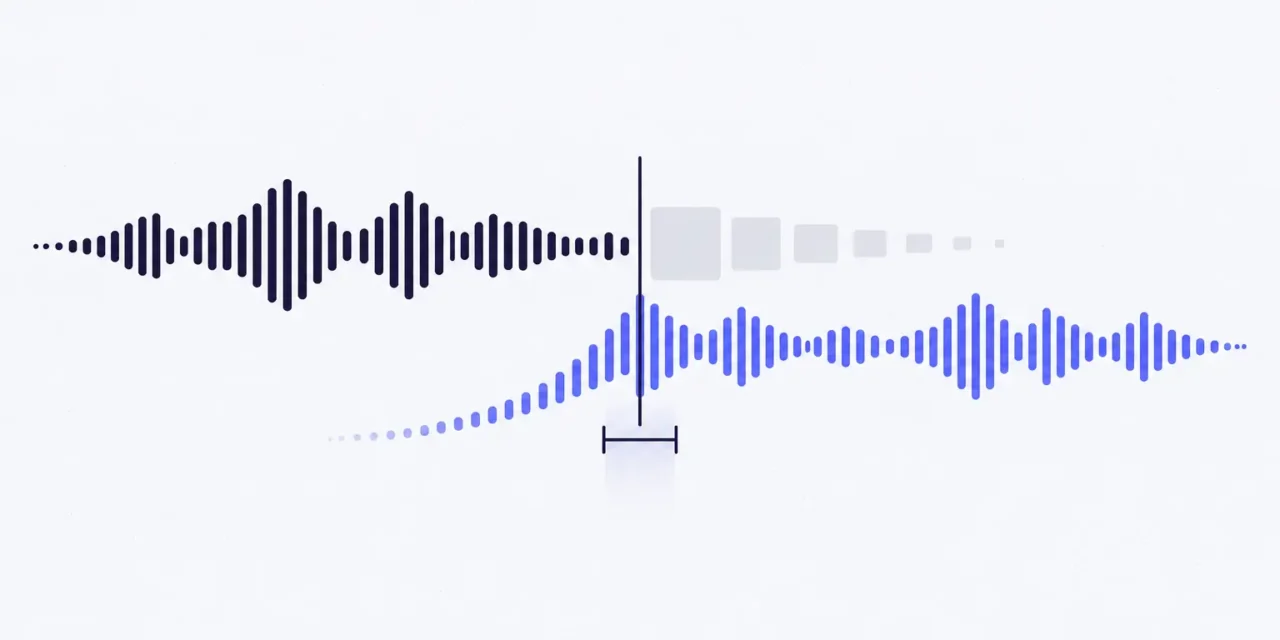
This is barge-in, and it is a timing problem rather than a speech problem. Three
things have to happen quickly: detect that the caller has started speaking, stop
the outgoing audio, and discard everything queued behind it. The last part catches
people out. Text-to-speech is usually generated ahead of playback, so at the moment
of interruption there may be several seconds of audio already synthesised and
buffered. Stopping the speaker is not enough; the buffer has to be thrown away too,
or the agent falls silent and then inexplicably resumes a sentence the caller
abandoned.
Detection is the other half. Cut too eagerly and the agent stops at a cough, a door,
a car horn — and on a noisy line it never finishes a sentence. Cut too late and you
are back to talking over people. The threshold is not one number: a mobile call from
a market and a desk phone in a quiet office need different sensitivity, and a good
system adapts to the noise floor it measures on that leg rather than a value set
once in a config file.
The reason this is worth engineering properly is that it changes what callers do.
When interruption works, callers stop waiting politely through the menu and simply
say what they want. Average handling time drops — not because the agent is faster,
but because the caller stopped being forced to listen to the parts that did not
apply to them.
Measure it directly. Log the gap between speech-start detection and output-stop, per
call, and watch the distribution rather than the average. The tail is where the bad
calls live.
Hi, this is a comment.
To get started with moderating, editing, and deleting comments, please visit the Comments screen in the dashboard.
Commenter avatars come from Gravatar.